THIS ARTICLE HAS BEEN REPLACED BY CHAPTER 8A
IN "MATTER UNIFIED", THE HTML VERSION on
http://www.newphys.se/elektromagnum/physics/Tedenstig/own
THE NEW PARTICLE THEORY
By Ove Tedenstig/Stockholm Sweden 1999-07-25
Extracted from my book "Matter Unified" 1998, ISBN 91-973340-0-6. Also based on works in different periods with beginning at 1981. Also partly published in Toth Maatian Review and Galilean ElectroDynamics.
Web home site :
http://www.newphys.se/elektromagnum/physics/Tedenstig andhttp://www.newphys.se/elektromangum/physics/Tedenstig/own
Email :
ove.tedenstig@swipnet.seFor more detailed information, see my book "Matter Unified" .
================================================================
We do not believe on quarks. We do not believe on gluons holding particles together. We do not believe on the way of classification of particles as done in current particle physics. We think the conceptual base of today particle physics is mainly wrong. Hence, we must try to find another conceptual base of existence of elementary particles, constituting the least fundamental parts of what we name "matter".
In this theory we assume there exist a set of particles which are singular, mainly/approximately, point formed in shape. The u-on, the k-on, the proton, the Tau-on are examples on such particles (the electron is outside and some unique). Combination of these base particles (where even the electron is included), create complex particle forms consisting of at least 2 and more particles of the first class. Examples on such particles are the neutral Pi-meson, the neutral k-meson, the neutron, the neutral Lambda neutral particle and many others.
The creation and behaviour of point singular particles
Our first task is to find a basic principle by which point formed particles are created, how they behave and how they get different mass content in spite of they have the same content of electric charge (the electron unit charge 1.6E-19 As). The solution of it is a rotating ring, a torus, which vibrate and interacts with its own electromagneticfield surrounding it.
|
Ro R Po Vo V Ao A s Po P Peff Mo me c vi q Tc Tr n |
the particle radius in not oscillating, neutral state the intermittent particle radius when oscillating the particle internal pressure when R = Ro the particle volume when in neutral state the particle volume when in oscillating state the limiting particle area in neutral state the limiting particle area when in oscillating state a small oscillating amplitude in the particle radius the total particle internal pressure at neutral state the total particle internal pressure at oscillating state the total effective force being the difference P - Po the total mass content of the particle the electron rest mass the light velocity in vacuum the internal spin velocity in a particle the mass density in vacuum 1/Eo the revolution time of particle around its own axis the particle oscillating time in the radius direction the particle's quantum resonance state value, 1,2,3…. |
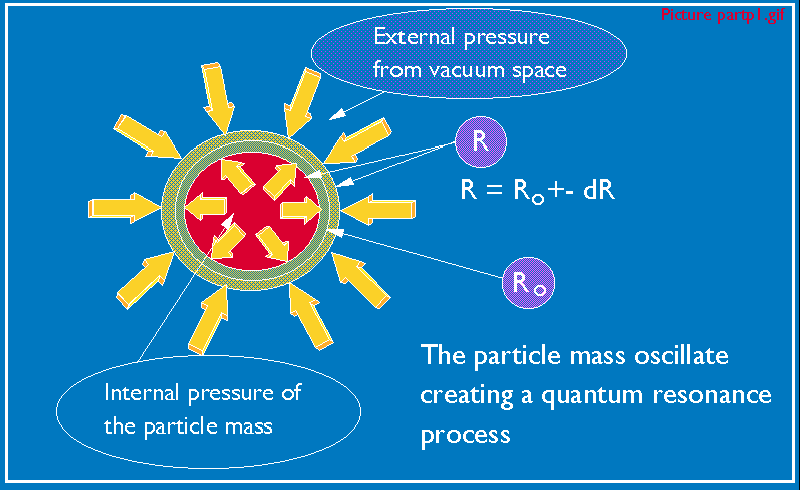
Picture partp1.gif
At start we look at a particle as a closed entity of matter in space. We begin by trying to formulate a differential equation, determining the oscillating movement of the particle plasma in the radius direction. We start with Boyle's law for gases, saying that the product of pressure and volume in a closed entity, is an invariant entity, provided the temperature is constant.
Picture partf1.gif
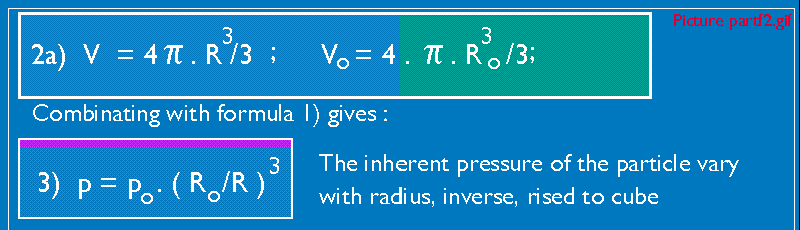
For the simplicity we assume the particle mass entity has a spherical form, giving the following relation between neutral state and oscillating state:
Picture partf2.gif
The total acting force on the particle's surface in the neutral state and in an oscillating state (compressed or de-compressed) then will be:
Picture partd3.gif
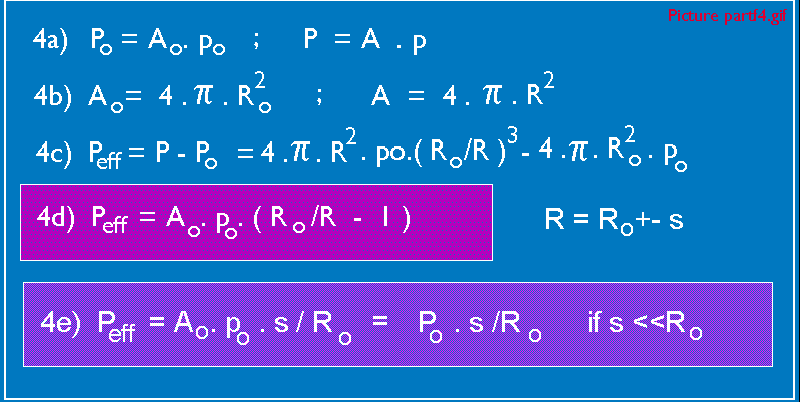
This force interacts with the particle mass inertial force when oscillating. Then in accord with Newton's law of force and mass, the inherent, expanding force will be
Picture partf5.gif

In each moment of time, these two forces are equal, hence in balance. That gives us the following differential equation, describing how the particle plasma will oscillate as result of mass and forces involved:
Picture partf6.gif
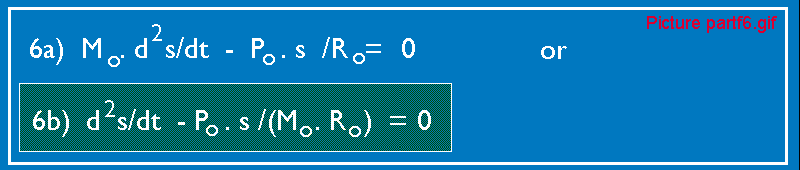
Making it possible to solve this differential equation, the parameter Po must be known. Further we must know how the particle mass is related to its spatial extension, the radius Ro. We begin with by computing Po. In each oscillating period, a mass, dm , is exchanged between particle and the vacuum space, having density 1/
eo. We calculate this mass and the energy associated to it, using the "relativistic" formula E = m.c(2).Picture partf7.gif
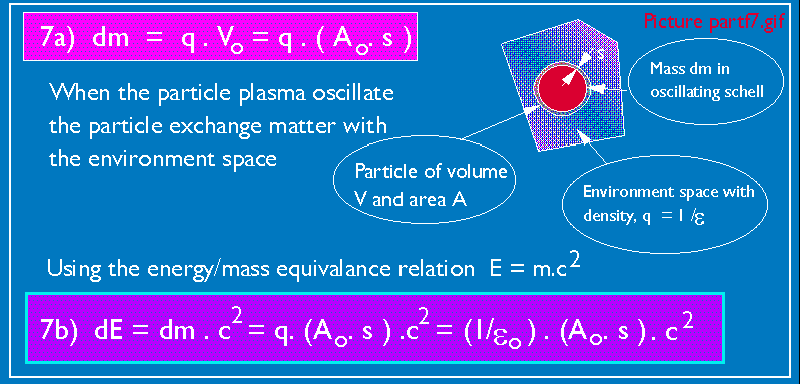
But according Newton's laws, energy is the product of force times distance, giving:
Picture partf8.gif

From our atomic and electromagnetic theory, we know that the mass density of all point formed base particles have approximately the same mass density. Using the electron as our reference particle with radius, re, then the mass of an arbitrary point particle has the mass:
Picture partf9.gif
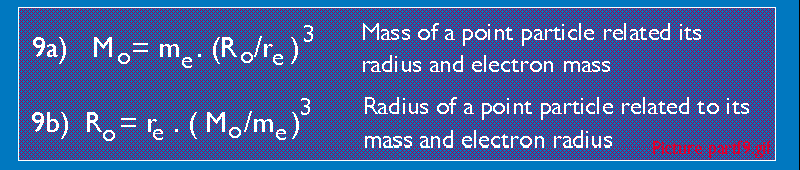
Now we calculate the variable Po/(Mo.Ro) in our differential equation 6b). We start with Po from formula 8) and insert value of M from formula 9a, divided with Ro. After that the
eo is replaced by values from formula 10a), 13c) from our electromagnetic theory, and Ao is rewritten by use of formula 9a) from the same theory, giving:Picture partf10.gif
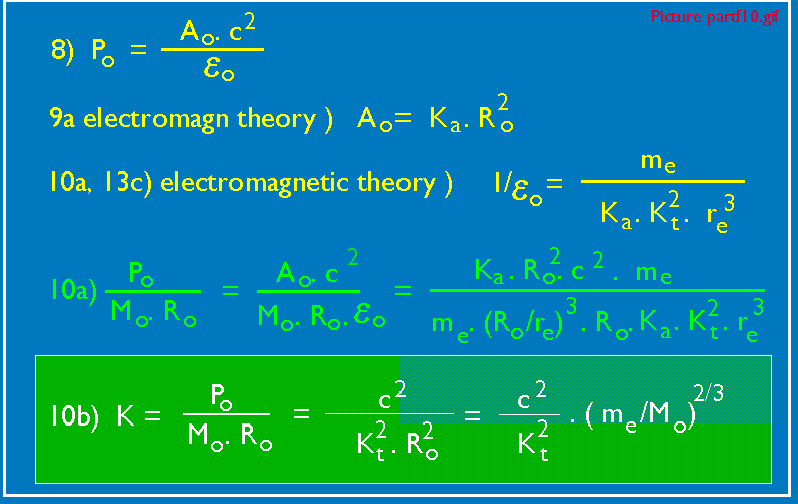
The solution of our differential equation 6b) then will be:
Picture partf11.gif
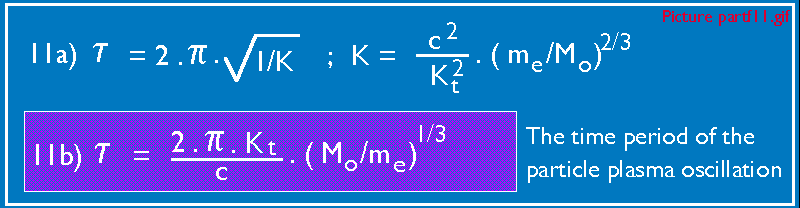
These vibrations of the particle plasma in the radius direction, generates disturbances in the surrounding particle's electromagnetic field, giving rise to a resonance effect (a quantum effect) between these vibrations and the particle's vibration in its own electromagnetic field.
The particle's oscillation in its own electromagnetic field can be calculated from the common pendulum equation in the same way as here demonstrated in equation 6b). The electromagnetic field force is here me.c(2)/re, the particle mass, M , and the pendulum radius, R, giving:
Picture partf12.gif

The particle's oscillation in the radius direction (time period
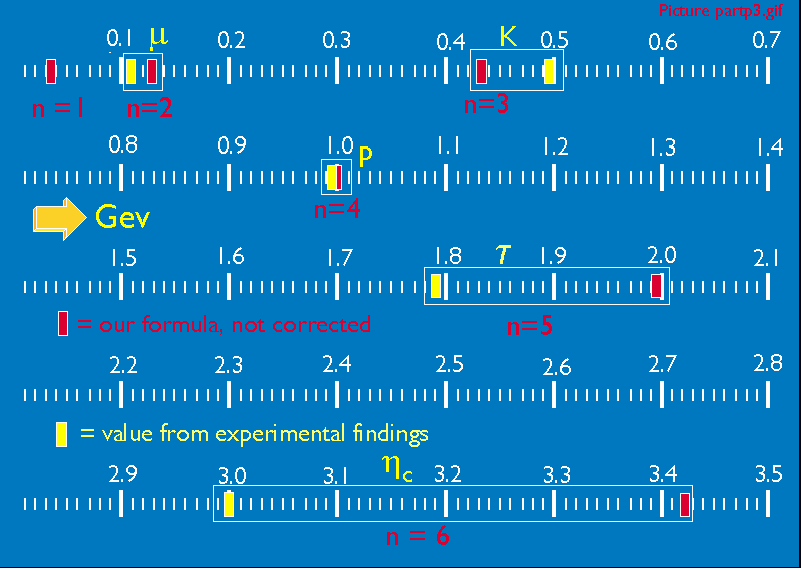
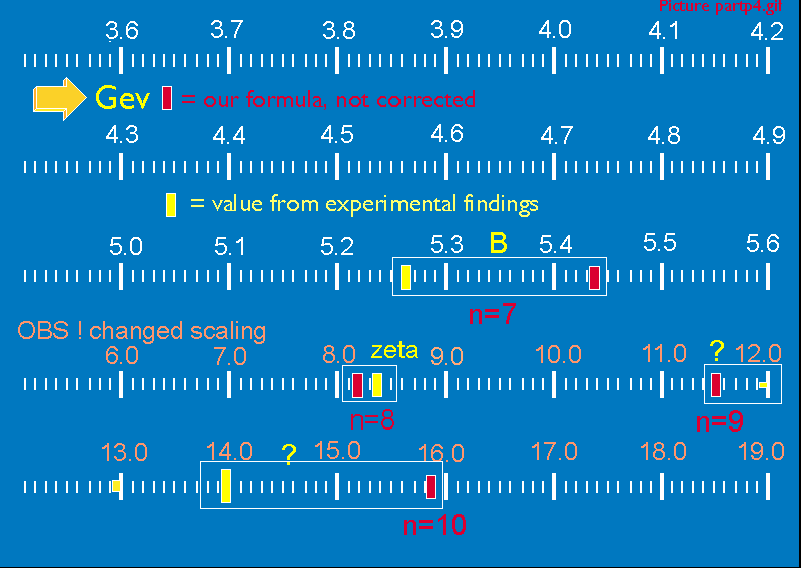
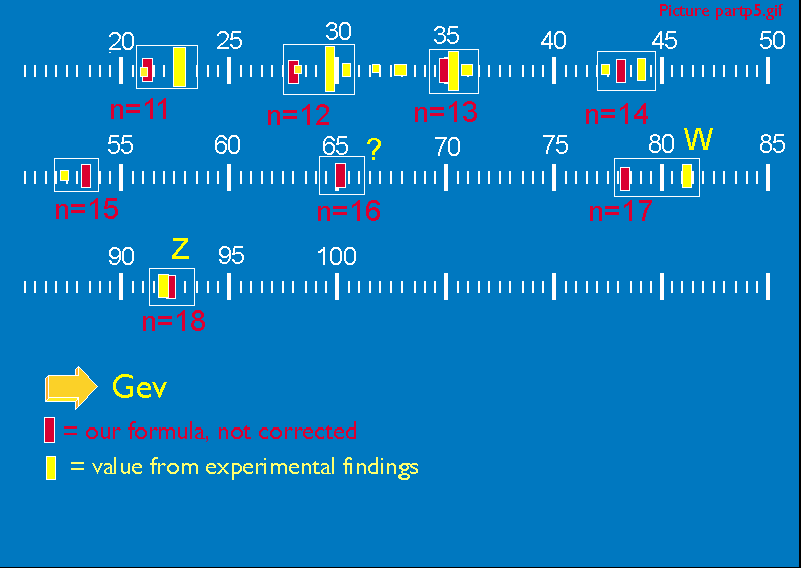
tr ) will be in resonance with the particle's oscillation ( time period tc ) in its own electromagnetic field, times an half integer n of it. We prefer to express the equation in full integer values, introducing an correction factor k = 1+-0.06 times the number of p, giving the following set of formulae :Picture partf13.gif

Some of these point formed base particles can be identified as follows :
Picture partp2.gif

M = me.( k . n . p )3
===================================
where : me = electron rest mass
k = 1+-0.06
n = an integer quantum number 1,2,3,4.....
p = 3.141592......
M = the calculated particle mass value
n Mass from experiments Unit Value of k Comment
Some statistics got from Physics Review Letters
Red mark is from our theory
|
Energy/Events |
Energy/Events |
Energy/Events |
|||||||||
|
10 |
Gev |
26 |
Gev |
42 |
2 |
Gev |
|||||
|
11 |
11.5 |
" |
27 |
1 |
27.4 |
" |
43 |
43.4 |
" |
||
|
12 |
1 |
" |
28 |
" |
44 |
7 |
" |
||||
|
13 |
2 |
" |
29 |
49 |
" |
45 |
" |
||||
|
14 |
8 |
" |
30 |
5 |
" |
46 |
" |
||||
|
15 |
15.8 |
" |
31 |
1 |
" |
47 |
" |
||||
|
16 |
" |
32 |
" |
48 |
" |
||||||
|
17 |
1 |
" |
33 |
2 |
" |
49 |
" |
||||
|
18 |
" |
34 |
5 |
34.8 |
" |
50 |
" |
||||
|
19 |
" |
35 |
15 |
" |
51 |
" |
|||||
|
20 |
" |
36 |
2 |
" |
52-57 |
1 |
53.4 |
" |
|||
|
21 |
1 |
21.1 |
" |
37 |
" |
53 |
" |
||||
|
22 |
12 |
" |
38 |
" |
54 |
" |
|||||
|
23 |
" |
39 |
" |
55 |
" |
||||||
|
24 |
" |
40 |
" |
56 |
" |
||||||
|
25 |
" |
41 |
" |
57 |
" |
||||||
Picture partp3.gif
Picture partp4.gi
Picture partp5.gif
To be proceeded later, discussing neutral particle forms and other more complex particle forms.
See also
http://www.newphys.se/elektromagnum/physics/Tedenstig, my book"Matter Unified"